






The Island of Glass
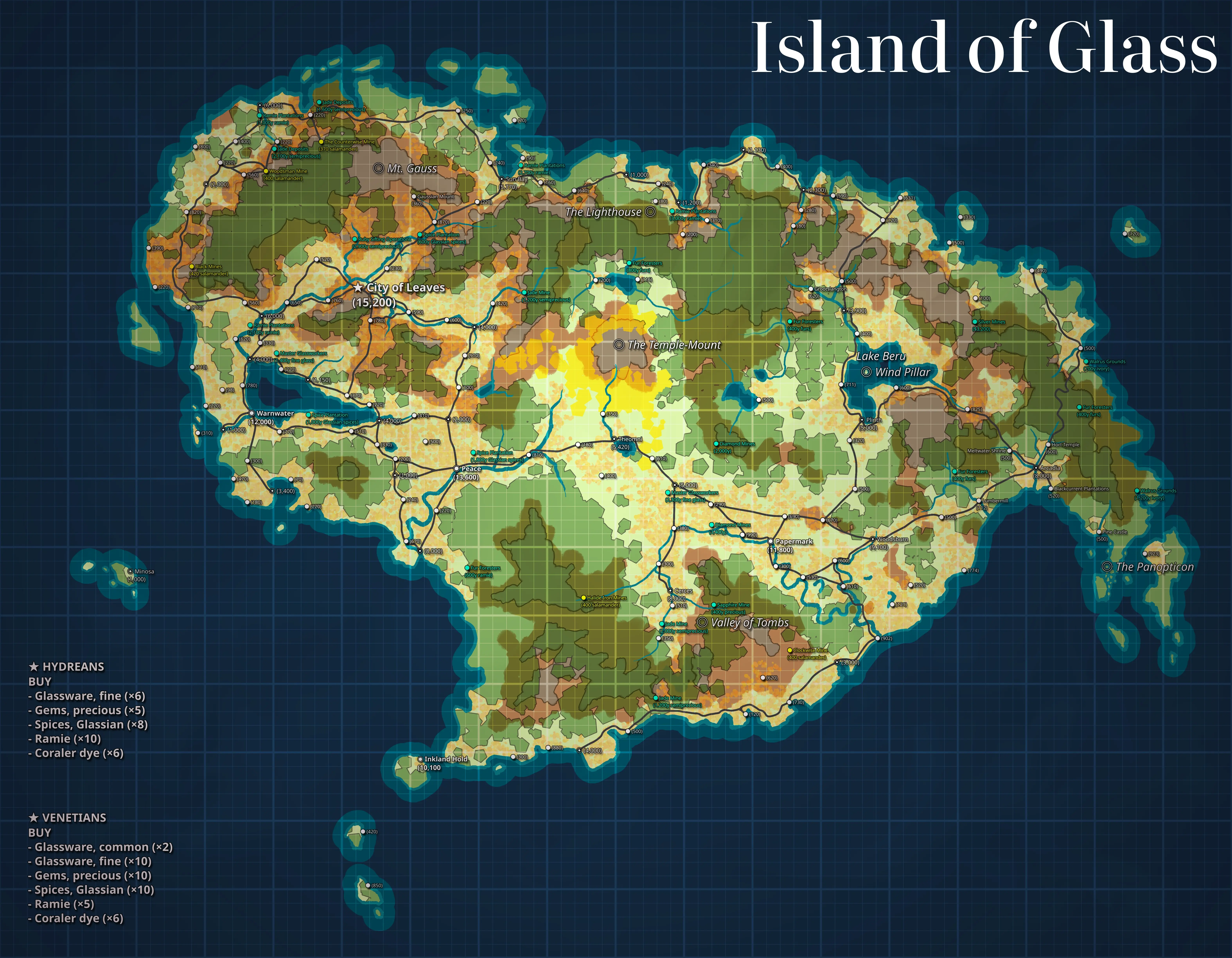
Glass is an island roughly half the size of Honshu, triangular in shape, with a long mountain range on its counterclockwise side and a smaller cluster of peaks to its clockwise point. The land between forms a raised valley — temperate, fertile, and increasingly scarred by war.
Measurements
| Metric | Value |
|---|---|
| Area | ~50,000 sq. mi (similar to Hokkaido) |
| Farmland | ~17,000 sq. mi |
| Wilderness | ~20,000 sq. mi |
| Dangerous Wilderness | ~14,000 sq. mi |
| Estimated Maximum Families | 81,600 (~24 per sq. mi of farmland + urban) |
| Actual Current Human Families | ~64,000 |
| Wilderness Harpy Families | 1,380 |
| Domestic Harpy Families | 1,280 |
| Capital Population | 76,000 |
A Family averages ~5 people: a husband, wife, one capable child, and two dependents. The City of Leaves alone holds 15,200 Families.
The Structure of Glass Society
The general national stance is that Glassians are free, and furthermore that Glassians are equal in death — through reincarnation. This status quo was established & enforced by Kain, an immortal tyrant who could not be challenged by anyone who sought to overthrow him. This force of will sustained a free perspective on the world that couldn’t be developed elsewhere.
Everywhere else on Aia is caught in the Bronze Age optimization cycle. Every other god & king on Glass is subject to mortal power concerns — evolutionary pressures to optimize the cycles of fertility, war, & slavery. This extended not just to temporal rulers but also to gods, who (being little more than super-powered & sometimes ageless mortals themselves) were no better than their contemporary rulers in requiring maximum possible extraction of labor from increasingly dehumanized serfs & peasants to compete in war.
Worse, the impact of conquest on personal power creates a cycle of Flower War-style low-intensity conflict. Because men only grow powerful when exposed to war, most societies advance towards ensuring a constant state of conflict with neighbours in order to avoid producing weak heirs whose rule can be challenged by internal or external enemies. The most accomplished conquerors are capable of fighting a thousand swordsmen toe-to-toe & winning single-handedly. Their heir has no such power unless he replicates his feats.
The Commons loved Kain. Kain was not a moral or lawful man — he was a flippant, arbitrary murderer — but he was a stabilizing force with no dependencies & little to ask from his subjects other than that conflict be kept low. The common man, with nothing to gain from ruling his fellow Glassian, finds freedom in the yoke placed upon his masters.
But the magistrates hated him. For every ten thousand commoners, an elite of exceptional administrative & military talent was being exposed to the arbitrary & absurdist rulings of a man focused on keeping them chained with as little personal effort expended as possible. Every single lord plotted silently against Kain — silence for fear, but of intent nonetheless.
Social Classes
The current distribution of Glass’s population is a snapshot of a society coming apart. Kain kept everyone roughly in their place; without him, the machinery of class is grinding loudly. Each entry below gives the percentage, the human reality behind it, and the conflict it creates at the table.
Quick reference:
| Class | % | In a village of 100 people… |
|---|---|---|
| Commoners | 70% | 70 people selling their labour for a bed and a meal |
| Burghers | 15% | 15 shopkeeps, artisans, and merchants |
| Outlaws / Mercenaries | 8% | 8 people living outside the law (1-2 of them dangerous) |
| Servants | 5% | 5 hereditary household servants |
| Slaves | 5% | 5 indentured labourers working off debts |
| Magistrates | 2% | 2 scholar-bureaucrats |
| Lords | 1% | 1 noble with a sword and a claim |
| Jesters | ~1% | 1 shrine-keeper trying to keep the gods happy |
| Imperial Family | negligible | You are unlikely to meet one in your lifetime |
| Foreigners | 3% | 3 non-Glassians trying to survive |
The Commons
- How to enter: If you’re a Glassian & not a Governor, you’re here by default.
- How to escape: Fall into debt & become a Slave. Find a Magician willing to train you. Catch the eye of a Governor.
Eighty-five percent of Glassians are nominally free. They are free to work, free to prosper, free to fall, and free to starve. The state does not protect them; it merely does not enslave them. For Aia, this was an astonishing luxury that is rapidly falling to pieces.
Glass was prosperous under Kain, and the war is eating that prosperity. Most Commoners (70%) are labourers, farmers, soldiers, and entertainers who sell raw labour to survive. Many live tolerably well by mainland standards, but the civil war has reversed that trajectory. Every season brings more conscription, higher taxes, bandits, and villages that simply stop reporting. What divides the Commons is not wealth but security: some still have what Kain left them, and many have watched it burn. Many once aspired to become Burghers; that path has rapidly closed with the onset of the war.
The middle class is terrified of its rank, relative to the powerful. Burghers (15%) are entrepreneurs, artisans, merchants, and moneylenders — the economic engine of Glass. They have the coin to matter but not the blood to defend it. A Lord can demand, a Magistrate can rule, a war can burn. Every Burgher knows their prosperity is a lease, not a deed, and they desperately want what the Governors have: the security that wealth alone cannot buy. Their children are sent into Magistrate education, the most reliable path across the line.
- See also: Commoner bestiary entry, Burgher class, Army factions, Business factions, Equipment & prices
Outlaws & Foreigners
- How to enter: Lose your land & take up a spear. Flee the law or be exiled. Be shipwrecked on a shore that has no path to citizenship.
- How to escape: Buy a patron’s favor. Marry into a Burgher line. Become a slave from debt. Make yourself too useful to prosecute. Find a boat that can leave Glass.
Roughly one in ten Glassians live outside the law’s protection (8% outlaws, 3% foreigners). The reason why determines what they have & what they can lose.
Mercenaries are tolerated only as long as the war pays. Between contracts, a mercenary is just a vagrant with a weapon. A lord who hired you yesterday will hang you tomorrow if you are caught stealing from his granary. The only thing that keeps a mercenary safe is the war not ending.
Criminals are safe only as long as they stay invisible. Bandits, smugglers, and murderers live by one rule: do not become someone else’s bounty. A criminal with a patron is protected; one without is a reward. The war has been very good for criminal business, but the same chaos that creates customers also attracts wolves.
Foreigners are safe only as long as they are useful. Non-Glassians have no legal standing, no path to citizenship, and no recourse if they are robbed, imprisoned, or killed. A foreigner with a lord’s favor can thrive. One without it does not survive long. Every party will eventually have to decide whether that bothers them.
- See also: Gangster class, Army factions, The Commons’ Revolt
Servants
- How to enter: Be captured in war & assigned to a household. Be born to a Servant.
- How to escape: Persuade your master to free you. Flee into the outlaw population.
Servants are 5% of Glassians, and half of the 10% non-free population: permanent, protected, and sealed outside citizenship forever. Servants are hereditary household staff descended from prisoners of war; coralers, salamanders, harpies, and foreign humans who fell in with the wrong camp & were kept for sport or as prizes. Strict laws protect their rights (they cannot be killed or maimed without cause), but they & their children can never become Glassian no matter how many generations pass under the same roof.
A Servant’s quality of life depends entirely on their master’s quality. A well-kept Servant means a secure Lord; a mistreated one signals trouble coming. There is no path out that does not involve abandoning everything they have ever known.
- See also: Coraler race, Salamander race, Harpy race
Slaves
- How to enter: Fall into debt & be assigned by court order. Have your contract bought by a creditor.
- How to escape: Serve your term. Buy out your contract. Flee — the war has made escape easier.
Slaves are the other half of the indentured on Glass: temporary, exposed, and Glassian. Unlike Servants, Glassians can become Slaves; voluntarily to pay a debt, or involuntarily by court order. The indentured population has nearly doubled since the war began … as has the rate of fugitive slaves. An indenture is a debt, and debts can be sold. A Slave’s term can be bought, sold, extended, or cut short by their creditor’s fortunes.
A Slave met on the road might be an escaped debtor, a fugitive, or someone whose contract was bought by a faction the Party is at war with. The only thing a Slave has that a Servant does not is a finish line — and between now & that day, they have no protection at all.
- See also: Debt & Credit, Retainers & Hirelings
The Magicians
- How to enter: Be born into a Jester family or persuade one to train you. Find a magician from a foreign tradition willing to teach you. Be a non-Glassian who already practices a tradition of your own.
- How to escape: You cannot truly stop being a magician. The spirits know you. You can stop practicing, but the connection remains.
Magicians are spirit-speakers & god-keepers who tend shrines in exchange for power. On Glass, roughly one in a hundred people have the temperament, intelligence, skill, and opportunity to practice.
Jesters are the native tradition of Glass: shrine-keeping clowns who warn through trickery & story. They negotiate between Glass & its gods. Mistrusted by everyone, tolerated because nobody else can do the job. They are assumed neutral — welcome at all non-private social functions provided they do not act to harm anyone. This protection extends to all shrine grounds & general hospitality. Jesters are the only thing preventing the gods from simply wiping out the population, and everyone knows it. The role is stereotyped as female, though the profession is evenly split.
Other traditions exist on Glass; they are foreign, strange, and not traditional in any proper sense. This includes the Origami Assassin, Forester, Metallurge, Snowmime, and Telluric Priest. None are illegal; they are with the exception of the Origami Assassin simply non-native and (without exception) dangerous & weird to the average person, and in a collapsing empire that is suspicion enough. All magicians share the same instability: magic is horrifically dangerous, and few live long without suffering mutations or a horrific death. Many magicians end up as the right hand of conquerors, not the conquerors themselves.
- See also: Magician class, Magical Traditions, Jester tradition, Religion & Gods, Magic, Spells & Totems
Magistrates
- How to enter: Be elected or appointed. Burgher families send their children into Magistrate education.
- How to escape: Get fired. Lose a political struggle. Be caught in a corruption scandal.
Magistrates are the gatekeepers of legitimacy. They run the courts, treasuries, archives, and licensing; all the apparatus of state that turns a lord’s will into enforceable reality. In theory their position is at-will & merit-based, but in practice, powerful Magistrates command networks of allies among Lords & Burghers, and their offices often become hereditary in all but name. They can be fired, but only by someone with more power than them. A Magistrate’s real fear is the political struggle they cannot win.
- See also: Magistrate class, Government factions
Lords
- How to enter: Be born into a House. Persuade a Lord to adopt you (a flimsy bloodline justification is expected).
- How to escape: Lose a war. Have your titles seized. Abdicate.
Lords are walking factions. Every Lord traces their bloodline to Kain through one of his many bastard children — and after two millennia, this claim is more legal fiction than genealogy, but it is the foundation of all land rights on Glass. They command armies, hold cities as capitals, and fight small wars over titles & territory. The position is hereditary & male-only by common law, though exceptions exist — the kind of exception that starts a war of opportunity. A Lord’s name is an army, their word is a treaty, and their death is a succession crisis.
- See also: Lord class, House Arcades, House Eagle, House Beacon
Imperial Family
- How to enter: Be born into the Imperial House.
- How to escape: You cannot.
The Imperial Family holds what no one else can: the principle of rule itself. The current ruling house, descended from the Saint Emperor. Absolutely patrilineally hereditary. In a world where every other position can be lost, won, bought, or seized, this one cannot be acquired by any means short of erasing it entirely.
- See also: Imperial Family scenario, Oropolis & Kain